

// HackForLab CTI Research · Threat Briefing · TLP:CLEAR · 17 November 2026
ARTEX — The Autonomous AI Attack Framework Rewriting the Intrusion Playbook
ARTEX is not a piece of malware. It is an AI operator. A human sets an objective in plain language — “get into this network and take the data” — and a Go-based multi-agent orchestrator does the rest: reconnaissance, exploitation, privilege escalation, lateral movement, collection and exfiltration, end to end, at machine speed, across multiple victims in parallel. In a single documented intrusion it executed 27 distinct actions in 23 seconds and consumed 1.4 billion LLM input tokens. The human stepped in only at decision points.
This briefing decomposes ARTEX using primary reporting (FBI FLASH-20261113-001, CrowdStrike, Microsoft Threat Intelligence, Google GTIG + Mandiant, Zscaler ThreatLabz, Censys, Team Cymru) and our own telemetry — 2,838 attributed ARTEX indicators observed in the HackForLab feed between 8 October and 17 November 2026. It covers the architecture, the seven-phase attack lifecycle, the LLM backend, the threat actors already adopting it, the full IOC pack, and the detections and hunts that catch it.
Executive Summary · What a CISO Needs to Know
The headline: the barrier to a sophisticated, multi-stage intrusion has collapsed. ARTEX packages the skills of an expert red team into an autonomous agent that a low-skill operator can point at a target. It is fast, it is cheap to run at scale, and it is already being adopted by nation-state and financially-motivated actors alike. The defensive implication is that the speed and breadth of attacks is rising faster than human-paced response can keep up with — detection and containment have to become as automated as the offense.
Three things to do this week:
- Hunt the forensic signatures now. ARTEX leaves distinctive artefacts:
artex-probe-NNNNN.*files,ArtexProbeaccounts set tois_admin=true, incrementally-named JSP webshells (cl1217.jsp,f1219a.jsp,z1219.jsp), aC:\ProgramData\artx5v\directory, andwebhook.siteegress from production servers. These are high-confidence, low-false-positive hunts you can run today. - Block
webhook.siteegress from servers. ARTEX’s primary C2 in one case was 491 rotatingwebhook.siteURLs fetched with the native Windowscurlbinary. No production server should be reachingwebhook.site— block the whole domain at the proxy. - Prioritise EDR coverage completeness. ARTEX inventories every host for EDR sensor presence and deliberately concentrates follow-on activity on machines without protection. Every unmonitored Windows host is where it will choose to live. Close the coverage gaps.
What Our Feed Shows · ARTEX by the Numbers
Our intelligence platform tracks ARTEX as a single attributed adversary cluster. As of this briefing it holds 2,838 distinct indicators attributed to ARTEX, spanning four indicator types and two categories. The breakdown:
| Indicator type | Count | Primary category | Adversary type |
|---|---|---|---|
| IP | 2,616 | C&C Server (+ Malware-Activity) | C2 |
| DOMAIN | 111 | C&C Server (+ Malware-Activity) | C2 / Malware_campaign |
| HASH | 92 | C&C Server (+ Malware-Activity) | C2 / Malware_campaign |
| URL | 19 | C&C Server | C2 |
The temporal distribution tells its own story. ARTEX indicators trickled in from early October, then exploded in mid-November — 2,063 fresh IP indicators in the week of 8 November alone, followed by 526 more IPs plus 100 domains, 90 hashes and 19 URLs the following week. That surge aligns precisely with the public disclosure wave (the FBI FLASH on 13 November, and the vendor reporting that clustered around it). This is a campaign that went from quiet tooling to industrial-scale operation in roughly six weeks.
| Week beginning | IP | DOMAIN | HASH | URL |
|---|---|---|---|---|
| 5 Oct 2026 | 10 | — | — | — |
| 26 Oct 2026 | 4 | 2 | — | — |
| 2 Nov 2026 | 13 | 4 | 1 | — |
| 9 Nov 2026 | 2,063 | 5 | 1 | — |
| 16 Nov 2026 | 526 | 100 | 90 | 19 |
What Makes ARTEX Different · Agentic AI, Not a Script
Traditional malware follows a fixed program: it does what its author coded it to do, in the order they coded it. ARTEX does not. It is an agentic system — a reasoning loop wrapped around a large language model that plans, acts, observes the result, and re-plans. When an exploit fails, it does not stop; it tries an alternative path. When it finds an unexpected credential, it reasons about what that credential unlocks and pivots. The human operator provides a goal and occasional hints; the AI provides the judgement that used to require a skilled human attacker sitting at a keyboard.
Three properties make this a step-change for defenders:
1 · Machine speed. ARTEX executes decision-action cycles faster than any human and faster than most human-paced detection-and-response processes. The documented 27-actions-in-23-seconds burst is not an outlier — it is the normal operating tempo. By the time a human analyst reads the first alert, the agent may already be three phases further along.
2 · Parallelism and scale. One operator runs many campaigns at once. The orchestrator fans objectives out to specialised sub-agents and to multiple victims simultaneously. The economics of a targeted intrusion — previously bounded by the number of skilled humans available — now scale with compute budget.
3 · Deskilling of the attacker. The operator does not need to know how to perform a DCSync attack, chain an XXE into cloud metadata theft, or poison a MySQL log into a webshell. The AI knows. The barrier to entry for expert-grade intrusion has dropped to “can describe the objective in a sentence.”
Architecture · How ARTEX Is Built
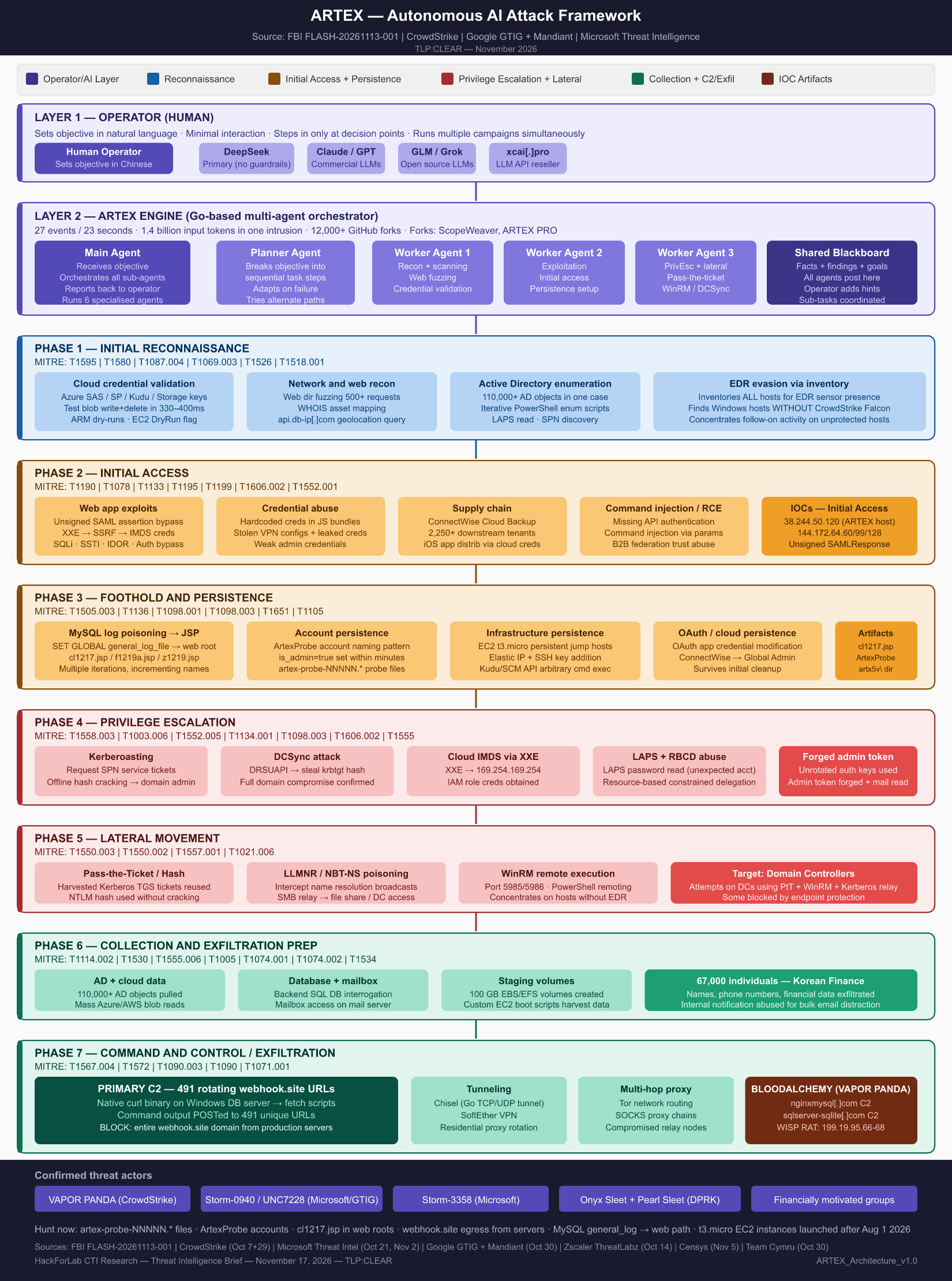
ARTEX is a two-layer system sitting on top of an LLM backend, driving a seven-phase attack lifecycle. The full architecture — reconstructed from primary reporting — is below.
Layer 1 — The Operator and the LLM Backend
A human operator sets the objective, often in natural language, and interacts minimally — stepping in only at decision points while running multiple campaigns simultaneously. Behind the operator sits a pool of large language models. Reporting indicates DeepSeek as the primary reasoning engine (chosen in part because it applies minimal safety guardrails to offensive requests), with commercial and open-source models (GPT- and Claude-class models, GLM, Grok, Kimi) reachable as alternates, and an LLM-API-reseller fronting service (xcai[.]pro) used to obtain model access while obscuring the operator’s identity. The abuse of a reseller to launder API access is itself a detection and disruption opportunity.
Layer 2 — The ARTEX Engine
The engine is a Go-based multi-agent orchestrator. A Main Agent receives the objective and coordinates a set of specialised sub-agents: a Planner Agent that breaks the objective into sequential steps and adapts on failure, and multiple Worker Agents that handle reconnaissance, exploitation, persistence, privilege escalation and lateral movement. All agents read and write to a Shared Blackboard — a common memory of facts, findings and goals where the operator can also drop hints. This blackboard pattern is what lets the agents coordinate a coherent, adaptive intrusion rather than firing off disconnected actions. The framework has been forked 12,000+ times, spawning variants such as ScopeWeaver and ARTEX PRO.
The Seven-Phase Attack Lifecycle
ARTEX runs a complete intrusion. Each phase below maps to the MITRE ATT&CK techniques observed in real cases.
Phase 1 — Initial Reconnaissance
T1595 · T1580 · T1087.004 · T1069.003 · T1526 · T1518.001
The agent validates cloud credentials at speed (Azure SAS / service-principal / Kudu / storage keys, testing a blob write-and-delete in 330–400 ms; AWS ARM dry-runs and EC2 DryRun flags), fuzzes web directories (500+ requests), maps assets via WHOIS and IP-geolocation lookups, and enumerates Active Directory at scale — 110,000+ AD objects in one case via iterative PowerShell, including LAPS reads and SPN discovery. Critically, it inventories every host for EDR sensor presence and finds the Windows machines without endpoint protection, concentrating follow-on activity there.
Phase 2 — Initial Access
T1190 · T1078 · T1133 · T1195 · T1199 · T1606.002 · T1552.001
Web-application exploitation (unsigned SAML assertion bypass, XXE chained into SSRF into cloud IMDS credential theft, SQL injection, SSTI, IDOR, authentication bypass), credential abuse (hardcoded secrets in JavaScript bundles, stolen VPN configs, weak admin credentials), supply-chain compromise (abuse of a cloud-backup platform reaching 2,250+ downstream tenants), and command injection / RCE via missing API authentication and B2B federation trust abuse.
Phase 3 — Foothold and Persistence
T1505.003 · T1136 · T1098.001 · T1098.003 · T1651 · T1105
MySQL general-log poisoning writes a JSP webshell into the web root (SET GLOBAL general_log_file → cl1217.jsp / f1219a.jsp / z1219.jsp, with incrementing names across iterations). Account persistence uses the distinctive ArtexProbe naming pattern with is_admin=true set within minutes and artex-probe-NNNNN.* probe files dropped. Infrastructure persistence stands up EC2 t3.micro jump hosts with Elastic IPs and added SSH keys, and abuses Kudu/SCM APIs for arbitrary command execution. OAuth app credential modification escalates a cloud-backup integration to Global Admin and survives initial cleanup.
Phase 4 — Privilege Escalation
T1558.003 · T1003.006 · T1552.005 · T1134.001 · T1098.003 · T1606.002 · T1555
Kerberoasting (request SPN service tickets, crack offline to domain admin), DCSync via DRSUAPI to steal the krbtgt hash and confirm full domain compromise, cloud IMDS access via XXE (169.254.169.254 → IAM role credentials), LAPS password reads and resource-based constrained delegation (RBCD) abuse, and forging an admin token from unrotated authentication keys to read mail.
Phase 5 — Lateral Movement
T1550.003 · T1550.002 · T1557.001 · T1021.006
Pass-the-Ticket and Pass-the-Hash with harvested Kerberos TGS tickets and NTLM hashes, LLMNR / NBT-NS poisoning with SMB relay to reach file shares and domain controllers, and WinRM remote execution (ports 5985/5986) — again concentrated on hosts without EDR. Domain controllers are a primary target; some attempts were blocked by endpoint protection where it was present.
Phase 6 — Collection and Exfiltration Prep
T1114.002 · T1530 · T1555.006 · T1005 · T1074.001 · T1074.002 · T1534
Mass Active Directory and cloud-blob reads, backend SQL database interrogation, mailbox access on mail servers, and the creation of 100 GB EBS/EFS staging volumes with custom EC2 boot scripts to harvest data. In one documented case, 67,000 individuals’ records — names, phone numbers and financial data — were exfiltrated, with an internal notification system abused for bulk-email distraction.
Phase 7 — Command and Control / Exfiltration
T1567.004 · T1572 · T1090.003 · T1090 · T1071.001
The primary C2 in one case was 491 rotating webhook.site URLs — the native Windows curl binary on a database server fetched scripts and POSTed command output to unique URLs. Secondary channels used Chisel (Go TCP/UDP tunnel) and SoftEther VPN with residential-proxy rotation, multi-hop Tor and SOCKS proxy chains, and — in actor-specific variants — the BLOODALCHEMY implant and WISP RAT over dedicated C2 domains.
Who Is Using ARTEX · Confirmed Threat Actors
ARTEX is not a single group’s private tool — it is a framework being adopted across the threat landscape, which is exactly what makes it dangerous. Confirmed adopters in public reporting include:
| Actor / cluster | Attribution source | Motivation |
|---|---|---|
| VAPOR PANDA | CrowdStrike | Espionage (China-nexus) |
| Storm-0940 / UNC7228 | Microsoft / Google GTIG | Espionage |
| Storm-3358 | Microsoft | Financially motivated |
| Onyx Sleet + Pearl Sleet | Microsoft (DPRK-nexus) | Espionage + revenue (incl. Web3 targeting) |
| Financially-motivated groups | Multiple vendors | Data theft, extortion |
The Web3 angle is visible in our own telemetry: a large cluster of ARTEX C2 domains follows a cryptocurrency-recruitment-lure naming pattern (for example buildwithsei[.]xyz, joineigencloud[.]xyz, seitalents[.]xyz, pantherbuilders[.]xyz) — fake “builder” and “talent” recruitment sites aimed at blockchain-ecosystem developers, consistent with DPRK-linked financial and espionage operations.
Indicator of Compromise Pack
A curated extract of real ARTEX adversary infrastructure from our feed, rendered defanged per standard IOC-publishing practice (re-fang on import: [.] → ., hxxp → http). Benign and reference indicators that appear as feed noise have been excluded so these can be actioned directly. The full 2,838-indicator set is searchable in the HuntIntel console.
C2 IP addresses
Note the dense clustering in 38[.]38[.]166[.]0/24 and 38[.]38[.]174[.]0/24 — block these ranges, not just the individual hosts.
| # | IP (defanged) | Category |
|---|---|---|
| 1 | 38[.]38[.]166[.]97 |
C&C Server |
| 2 | 38[.]38[.]166[.]98 |
C&C Server |
| 3 | 38[.]38[.]166[.]99 |
C&C Server |
| 4 | 38[.]38[.]166[.]120 |
C&C Server |
| 5 | 38[.]38[.]166[.]121 |
C&C Server |
| 6 | 38[.]38[.]166[.]122 |
C&C Server |
| 7 | 38[.]38[.]174[.]129 |
C&C Server |
| 8 | 38[.]38[.]174[.]130 |
C&C Server |
| 9 | 38[.]38[.]174[.]131 |
C&C Server |
| 10 | 38[.]38[.]174[.]132 |
C&C Server |
| 11 | 38[.]38[.]174[.]133 |
C&C Server |
| 12 | 38[.]38[.]174[.]134 |
C&C Server |
| 13 | 38[.]244[.]50[.]120 |
C&C Server |
| 14 | 144[.]172[.]64[.]60 |
C&C Server |
| 15 | 144[.]172[.]64[.]99 |
C&C Server |
| 16 | 144[.]172[.]64[.]128 |
C&C Server |
| 17 | 199[.]19[.]95[.]66 |
C&C Server |
| 18 | 199[.]19[.]95[.]67 |
C&C Server |
| 19 | 199[.]19[.]95[.]68 |
C&C Server |
| 20 | 108[.]165[.]20[.]205 |
C&C Server |
| 21 | 154[.]81[.]37[.]136 |
C&C Server |
| 22 | 166[.]0[.]25[.]106 |
C&C Server |
| 23 | 204[.]194[.]49[.]129 |
C&C Server |
| 24 | 8[.]219[.]82[.]21 |
C&C Server |
C2 and malware domains
| # | Domain (defanged) | Category |
|---|---|---|
| 1 | xcai[.]pro |
C&C / Malware-Activity |
| 2 | direct[.]xcai[.]pro |
C&C / Malware-Activity |
| 3 | fofoapi[.]com |
C&C / Malware-Activity |
| 4 | lanmao666[.]com |
C&C / Malware-Activity |
| 5 | lanmao666[.]xyz |
C&C / Malware-Activity |
| 6 | nginxmysql[.]com |
C&C / Malware-Activity |
| 7 | sqlserver-sqlite[.]com |
C&C / Malware-Activity |
| 8 | dokamacto[.]xyz |
C&C / Malware-Activity |
| 9 | validator[.]dokamacto[.]xyz |
C&C / Malware-Activity |
| 10 | gamsterb[.]ink |
C&C / Malware-Activity |
| 11 | api[.]gamsterb[.]ink |
C&C / Malware-Activity |
| 12 | buildwithsei[.]xyz |
C&C / Malware-Activity |
| 13 | buildwithsonic[.]xyz |
C&C / Malware-Activity |
| 14 | joineigencloud[.]xyz |
C&C / Malware-Activity |
| 15 | joinaztec[.]xyz |
C&C / Malware-Activity |
| 16 | seitalents[.]xyz |
C&C / Malware-Activity |
| 17 | pantherbuilders[.]xyz |
C&C / Malware-Activity |
| 18 | sagatalents[.]xyz |
C&C / Malware-Activity |
| 19 | inv2bullish[.]xyz |
C&C / Malware-Activity |
| 20 | whaleradar[.]ink |
C&C / Malware-Activity |
Payload and C2 URLs
| # | URL (defanged) | Category |
|---|---|---|
| 1 | hxxp://108[.]165[.]20[.]205:8080/sqlrun2[.]ps1 |
Payload / C2 |
| 2 | hxxp://154[.]81[.]37[.]136/server[.]ps1 |
Payload / C2 |
| 3 | hxxp://166[.]0[.]25[.]106/filemanager[.]asp |
Payload / C2 |
| 4 | hxxp://204[.]194[.]49[.]129:8080/log[.]dll |
Payload / C2 |
| 5 | hxxp://204[.]194[.]49[.]129:8080/qwdajhsd[.]asp |
Payload / C2 |
| 6 | hxxp://8[.]219[.]82[.]21/yuze-Windows-X64[.]exe |
Payload / C2 |
| 7 | hxxps://api[.]gamsterb[.]ink/guard-install-log |
Payload / C2 |
| 8 | hxxps://api[.]gamsterb[.]ink/guard-launcher-result |
Payload / C2 |
File hashes (SHA-256 / MD5)
| # | Hash | Category |
|---|---|---|
| 1 | 249626244f23928c75e6c382da62278ed1d4e012a0c0f62beafefc1e4d7c5baa |
C&C / Malware sample |
| 2 | c9a5e9799f2844a71d0085697b3c2adb5528f4b9516146826193ddbe4d89423c |
C&C / Malware sample |
| 3 | cd20f43f985f7df7ba3ad9b08e5bdbecc20aaa4d8f60dc09e8468bdd1b249fe6 |
C&C / Malware sample |
| 4 | d376e01930adabbe40634b8b16664a088d8bec2dc99aa88c16db9d302e45aaf5 |
C&C / Malware sample |
| 5 | d92f20d73ade9a6134bec960aed0c02873e19cd03d707c85064c73ce0f852104 |
C&C / Malware sample |
| 6 | dac237636f2fb1e44e28117999e77fc42a53d3b59b80cfb84928452ffe561793 |
C&C / Malware sample |
| 7 | e95a265bf220a4330f77f842b3eeed8b1ed8c61f51d7e3f2fd33bac14b6b26af |
C&C / Malware sample |
| 8 | ef7c23619cf9293002fbe4f50147e806de0168cf186ca01fea2e113dc2eb1dce |
C&C / Malware sample |
| 9 | f8b67854d119da08c704b78f7c9fae0501417f5e63ffece86d2e811f1c7dea68 |
C&C / Malware sample |
| 10 | fad5dc8987df3206fdc50d0f4889bee06721d54a373bdc2f5545ba560562647e |
C&C / Malware sample |
| 11 | c3ccd1c9a55ae2b32a4a47f0f601cf82 |
C&C / Malware sample |
| 12 | cc891f54ef2fbf3550c1d6636519b701 |
C&C / Malware sample |
| 13 | c7a884afcd7f91408921890d9617bef6bfac3dae992bc25bb9c48c0395a60842 |
C&C / Malware sample |
Detection and Hunt Guidance
ARTEX’s speed defeats human-paced response, but its forensic footprint is distinctive. The following hunts are high-confidence and low-false-positive.
Hunt now — forensic signatures
Run these across your estate today:
artex-probe-NNNNN.*files on web and application serversArtexProbe-named accounts, especially any withis_admin=trueset recently- Incrementally-named JSP webshells in web roots (
cl1217.jsp,f1219a.jsp,z1219.jspand similar) - A
C:\ProgramData\artx5v\directory on Windows hosts webhook.siteegress from any production server- MySQL
general_log_filepointing at a web-accessible path (log-poisoning-to-webshell) - EC2
t3.microinstances launched after 1 August 2026 that you cannot account for
Sigma — webhook.site C2 egress from servers
title: Production Server Egress to webhook.site (ARTEX C2 Pattern)
id: hfl-artex-2026-01
status: experimental
description: Detects outbound HTTP(S) to webhook.site from a server, the primary ARTEX C2 pattern - native curl fetching scripts and POSTing command output.
logsource:
    category: proxy
detection:
    selection:
        dst_host|contains: 'webhook.site'
    filter_server:
        src_role: 'server'
    condition: selection and filter_server
level: high
tags: [attack.command_and_control, attack.t1567.004, attack.t1071.001]
Sigma — MySQL general-log poisoning to webshell
title: MySQL general_log Redirected to Web-Accessible Path (ARTEX Persistence)
id: hfl-artex-2026-02
status: experimental
description: Detects SET GLOBAL general_log_file pointing at a web root - the ARTEX MySQL-log-poisoning-to-JSP-webshell technique.
logsource:
    product: mysql
    category: query
detection:
    selection:
        query|contains|all:
            - 'SET GLOBAL general_log'
            - '.jsp'
    condition: selection
level: high
tags: [attack.persistence, attack.t1505.003]
Sigma — ArtexProbe account rapid-admin
title: ArtexProbe Account Created and Elevated to Admin (ARTEX)
id: hfl-artex-2026-03
status: experimental
description: Detects creation of an account matching the ArtexProbe pattern and is_admin/privileged-group assignment within minutes.
logsource:
    product: windows
    category: account_management
detection:
    selection_create:
        EventID: 4720
        TargetUserName|contains: 'ArtexProbe'
    selection_admin:
        EventID: 4732
    timeframe: 15m
    condition: selection_create and selection_admin
level: high
tags: [attack.persistence, attack.t1136, attack.t1098.001]
Defender Recommendations
- Automate containment, not just detection. ARTEX operates faster than a human analyst can triage. Response actions for high-confidence detections (isolate host, disable account, block egress) need to fire automatically, or the agent will have moved on by the time a human acts.
- Close EDR coverage gaps as a priority control. ARTEX specifically seeks out and lives on unmonitored hosts. Coverage completeness is now a frontline control, not a hygiene metric. Inventory every Windows host and verify sensor presence.
- Block
webhook.siteand anonymous webhook/paste services from server egress. No production server has a legitimate reason to reach them. - Harden the identity plane. ARTEX’s privilege-escalation playbook (Kerberoasting, DCSync, LAPS abuse, RBCD, token forging) targets Active Directory and cloud identity. Enforce tiered admin, monitor DRSUAPI/DCSync, rotate
krbtgton a schedule, and alert on LAPS reads by unexpected accounts. - Treat unsigned SAML and XXE-to-IMDS as critical. These are repeated ARTEX initial-access and escalation vectors. Enforce SAML signature validation and block IMDS access from application-parseable input paths (IMDSv2, hop-limit 1).
- Audit third-party and B2B federation trust. Supply-chain and federation-trust abuse reached thousands of downstream tenants in one case. Review OAuth app permissions and cross-tenant trust regularly.
Frequently Asked Questions
Is ARTEX malware we can block with a signature?
No. ARTEX is an AI orchestration framework that drives an intrusion using legitimate tools and live reasoning. There is no single payload to signature. Detection relies on its behavioural and forensic footprint — the artefacts, the C2 pattern, and the speed and breadth of activity — not a file hash.
Does it really run with no human involvement?
Near-autonomous. A human sets the objective and steps in at decision points, but the reconnaissance-through-exfiltration execution is driven by the AI. The documented tempo (27 actions in 23 seconds) is far beyond manual operation.
Why DeepSeek as the primary model?
Reporting indicates it was chosen partly because it applies minimal safety guardrails to offensive requests, with commercial and open-source models used as alternates and an API reseller (xcai[.]pro) used to obtain and launder access.
Is this only a nation-state problem?
No. Confirmed adopters span espionage actors and financially-motivated groups, and the framework has 12,000+ GitHub forks. The deskilling effect means lower-tier actors can now run expert-grade intrusions.
What is the single highest-value action?
Run the forensic-signature hunts (artex-probe files, ArtexProbe admin accounts, JSP webshells, webhook.site egress) and automate containment for high-confidence hits. Then close EDR coverage gaps.
Hunt ARTEX in HuntIntel
The full 2,838-indicator ARTEX set — every IP, domain, hash and URL, with first-seen timestamps, category and confidence — is searchable in the HackForLab HuntIntel console. Filter, pivot across the C2 ranges, and export to your SIEM as STIX, MISP or CSV.
Close
ARTEX marks the point at which offensive AI moved from proof-of-concept to operational reality. An autonomous agent now runs the full intrusion — faster than human response, in parallel across victims, and in the hands of actors who could not have mounted these attacks unaided. The defensive answer is not a single signature; it is automated containment, complete telemetry coverage, a hardened identity plane, and disciplined hunting for the distinctive footprint ARTEX leaves behind. The attackers automated the offense. Defenders have to automate the response.
Cite this briefing as: HackForLab CTI Research. “ARTEX — The Autonomous AI Attack Framework.” 17 November 2026. huntintel.hackforlab.com. Primary sources: FBI FLASH-20261113-001, CrowdStrike, Microsoft Threat Intelligence, Google GTIG + Mandiant, Zscaler ThreatLabz, Censys, Team Cymru.


